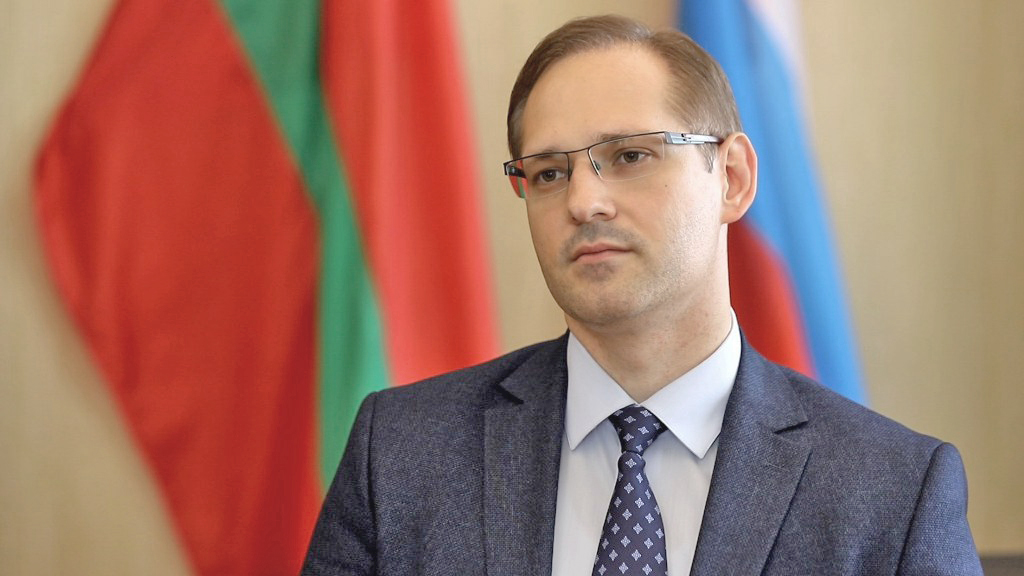
PMR Foreign Minister Vitaly Ignatiev gave an interview to news agency RIA Novosti, discussing the current state of dialogue with Moldova, international interest in the settlement process, economic pressure from Moldova, and its latest “initiatives” in negotiations with the PMR. He also answered questions about the distortion of historical memory in the neighboring country and the significance of the peacekeeping operation for Pridnestrovie.
Pridnestrovie and Moldova marked another anniversary of the outbreak of hostilities along the banks of the Dniester River. Officials in Chisinau claimed that Russia was allegedly the instigator and aggressor in the conflict. How does Tiraspol view such statements? What impact might they have on the Pridnestrovian settlement process?
The neighboring country has long excelled in historical insinuations. Thus, in textbooks for grades 9 and 12, Antonescu is not a Nazi executioner and Hitler’s accomplice, but a “competent administrator”, while Soviet liberators, who saved Europe from fascism, are labeled “occupiers”, and the memory of the Holocaust is completely distorted. I would like to emphasize that we are not the only ones insisting on the need to remove these textbooks from the Moldovan educational system. This demand is supported by the consolidated position of the Jewish communities of Pridnestrovie and Moldova, the Holocaust memorial centers Yad Vashem (Jerusalem) and Elie Wiesel (Bucharest), as well as many other organizations and scholars.
In the case of the Moldova-Pridnestrovie conflict, the history of which is well documented, it is particularly easy to debunk propaganda myths. The facts are that, at every stage of the conflict, Chisinau escalated the spiral of confrontation and bloodshed by ordering punitive operations in Pridnestrovian settlements, authorizing terrorist attacks on Pridnestrovian territory, and subsequently organizing a full-scale attack on the peaceful city of Bendery in violation of the concluded ceasefire agreements.
In this light, attempts to portray the actual aggressor as a victim appear not only absurd but also sacrilegious in the face of the memory of hundreds of Pridnestrovians whose lives were destroyed due to the criminal orders of the Moldovan authorities and the monstrous acts of those who carried them out.
We will continue to seek a legal assessment from the Moldovan side regarding the events of the early 1990s, with recognition of its guilt and responsibility for crimes committed against the Pridnestrovian people. In our interactions with the Moldovan political representative, we have clearly stated this demand. Only in this way can we turn this tragic page in the history of Moldova-Pridnestrovie relations and move forward. However, as long as war criminals and terrorists are glorified in Moldova, and as long as the blame for unleashing the conflict is shifted onto the country that, on the contrary, stopped it, there is, unfortunately, no point in discussing this.
After a long pause, a meeting between political representatives of Moldova and Pridnestrovie took place in Tiraspol. In reality, however, there has been a noticeable decline in contacts between the two sides. What could this lead to?
For more than six years now, the “5+2” international format has been blocked due to Moldova’s fault. No meetings of the parties’ top leadership have been held, despite repeated initiatives by Pridnestrovie. In recent years, within the framework of contacts between political representatives, the Moldovan side has increasingly sought pretexts to refuse to work at this level.
The fact that, after nearly a year of an unjustified hiatus, we managed to hold an official meeting can be viewed positively. However, the propagandistic approach demonstrated by my counterpart at the meeting in Tiraspol suggests a performative character of Moldova’s participation. I note that the representative of the Republic of Moldova was forced to admit that he lacked a mandate to discuss political issues. At the same time, even regarding less conceptual, primarily administrative and technical issues, he refuses to seek solutions. A logical question arises: how does Chisinau intend to reach decisions in the interest of the people if the authorized representative is not even ready to sign a technical protocol on child social protection, agreed upon by sectoral experts from Pridnestrovie and Moldova back in February 2020?
There are questions regarding the actual role of the Moldovan representative on political issues, who actively gives interviews but distances himself from substantive political and diplomatic work. The Moldovan side has no concrete achievements or practical results, but there is a lot of noise and the appearance of progress. It seems that this is Chisinau’s main goal at this stage.
Chisinau recently announced new initiatives aimed at fostering closer ties with Pridnestrovie. For example, the creation of a convergence fund. What is Tiraspol’s position on this matter?
“Rapprochement” projects cannot be created at the expense of illegitimate levies on Pridnestrovians and imposed unilaterally, without our consent and constructive discussion within existing negotiation frameworks. It is obvious that such methods achieve the exact opposite goal – division. Our citizens see and understand everything. Therefore, this “initiative” is nothing more than a smokescreen, including for international partners, whose sole purpose is to try to justify the levies on Pridnestrovie, the amount of which Chisinau, moreover, plans to increase.
How does Tiraspol view Chisinau’s recommendation to introduce the study of Romanian in Latin script in Pridnestrovian schools?
As is well known, there are three official languages in Pridnestrovie: Moldovan, Russian, and Ukrainian. Citizens are free to choose which of these their children will study. Any form of pressure or coercion is unacceptable. Judging by the propaganda theme chosen by the Moldovan political representative, Chisinau has still not realized or learned the lessons from the tragedy of the armed aggression unleashed against Pridnestrovie in 1992, the root of which lies in attempts to ban people from using their native language, impose a foreign one, and “erase” their identity.
If Moldova intends to genuinely build closer ties with Pridnestrovie, it must begin by granting official status in Moldova itself to the Moldovan, Russian, and Ukrainian languages, in addition to the existing Romanian language. This is a concrete step in the spirit of “convergence” toward the multinational people of Pridnestrovie, one that respects their identity. This approach is fully consistent with international standards and European norms and practices. Such a decision is the best way to demonstrate the transparency and democratic nature of Moldova’s ethnolinguistic sphere. Pridnestrovie has officially submitted this initiative; we await the Moldovan side’s response.
The Dniester riverbanks are regularly visited by high-level delegations from the EU and the U.S. What issues does Tiraspol raise in these meetings? How do Brussels and Washington respond to the lack of dynamics in the negotiation process? Are they ready to help activate the dialogue?
During these meetings, a wide range of issues is discussed, covering both the bilateral agenda and the negotiation process. The EU and the U.S., as observers in the “5+2” format, recognize that the situation in Moldova-Pridnestrovie relations is deteriorating and wish to understand the current state of affairs. We note that the absence of productive dialogue, combined with Moldova’s illegitimate pressure on Pridnestrovie, accompanied by massive violations of human rights and freedoms, is an extremely dangerous combination fraught with long-term negative consequences. This situation has arisen, in no small part, due to the passive behavior of certain mediators. Current conditions require more active mediation to prevent the crisis from escalating. And we see that among international participants, there is a growing understanding that the current approach of blocking the negotiation process is a dead end, and progress can only be achieved by resuming dialogue.
Chisinau and Kyiv claim that Russian peacekeepers allegedly pose a threat to this region of Europe. Moldovan Deputy Prime Minister Valeriu Chiveri believes that Russian troops are hindering the reintegration process. What does the presence of Russian troops mean for Pridnestrovie today?
No matter how many insinuations are made about the Russian-led peacekeeping operation, they all inevitably come up against one indisputable fact: today, just as thirty years ago, a lasting peace prevails on the banks of the Dniester. There are no gunshots; people can live peacefully, work, and raise children. This is due to the current peacekeeping mechanism, which since 1992 has served as a reliable safeguard against any forceful manifestations of the unresolved conflict. For Pridnestrovie, this means the opportunity to develop and a reliable guarantee of peace, which is especially needed now, against the backdrop of Moldova’s militarization and its refusal to engage in meaningful dialogue with Pridnestrovie.
For two years now, Tiraspol has been saying that Moldova has imposed customs duties on Pridnestrovian economic entities. Now, Chisinau is pushing for the introduction of new taxes: the abolition of excise taxes and the implementation of VAT. What might all this lead to? Are there any rough estimates of the losses resulting from these decisions by Chisinau?
Losses resulting solely from Moldova’s illegal customs duties are already estimated at tens of millions of dollars, with more than 13 million of that amount occurring last year. These losses are particularly acute at this stage, as Pridnestrovie continues to bear significant costs associated with the humanitarian and energy crisis and faces challenges in filling its budget, which directly affects the fulfillment of basic social obligations to the population, such as the payment of pensions, salaries, and benefits. Naturally, an increase in the “tribute” levied by Chisinau in the form of new taxes and fees will place an even greater burden on Pridnestrovie, leading to a decline in the population’s standard of living and worsening working conditions for economic agents.
Moldovan Minister of Culture Cristian Jardan recently stated that there should be no monuments to Grigory Kotovsky and Sergey Lazo at the center of Chisinau. At the same time, many have noted how Pridnestrovie has managed to preserve numerous Soviet monuments that attract tourists. Why do you think Tiraspol has managed to avoid a “war on monuments” and the rewriting of history?
Unlike neighboring Moldova, Pridnestrovie has a very healthy perception of its own history that does not fluctuate with the political climate. Pridnestrovians do not engage in rewriting historical events or fabricating ideologically convenient but false narratives. We view our history objectively and soberly: we honor the positive episodes, but we do not ignore dark, sorrowful chapters.
We do not want to leave our children a legacy of unlearned historical lessons. This is bound to have negative consequences, as the current global chaos confirms. Preserving historical memory is one of our state’s top priorities. That is why monuments from the imperial period and monuments from the Soviet era coexist harmoniously in Pridnestrovie. All of them are part of the unique historical heritage and the cultural and civilizational code of the Pridnestrovian people.